
October 9, 2026/
Coaching Excellence Solution-Focused Coaching vs. Traditional Coaching: What’s the Difference? Published October 9, 20265 min readSolution-Focused Leadership Table of Contents...

Industry research suggests that coaching in general delivers substantial returns. One study found that 68 % of individuals recoup their investment in coaching programs and that the average return for coaching is 3.44 times the cost. Companies report even higher returns—86 % of organisations recoup their investment, and some see ROI as high as 50×. While these figures apply broadly to coaching, credentials amplify the impact by signalling professionalism and adherence to best practices.
In this article, we will explore five ways an ICF credential can boost your income—often immediately. We will look beyond the obvious financial metrics to examine intangible benefits like increased confidence, professional networks and access to premium clients. We will also provide practical advice for maximising your investment and examples of coaches who leveraged their credential to thrive.
Professional coaching is an unregulated industry. Anyone can call themselves a “coach,” and many do. This has led to scepticism and confusion among potential clients who struggle to identify qualified providers. An ICF credential cuts through the noise. It tells clients that you have met strict training, experience and ethical standards, and that you engage in ongoing professional development. This credibility often translates directly into higher income.
Clients—especially corporate clients—are willing to pay more when they know they are hiring a credentialled professional. Consider the following income‑enhancing benefits:
Elena, a life coach based in Delhi, spent three years building a practice working primarily with individual clients. Her rates hovered around ₹2,500 per session (approximately US$30). After earning her Associate Certified Coach (ACC) credential, she applied for a leadership development contract with a multinational corporation. The company’s RFP specified that coaches must have at least an ACC. Elena won the contract and now charges ₹8,000 per session (≈US$96) for executive coaching. Over the course of a year, this contract alone tripled her income.
ICF membership and credentialing open the door to a global community of coaches. This network is not just for camaraderie; it is a pipeline of referrals, partnerships and ongoing education.
Practical Tip: Actively participate in your local ICF chapter. Attend meetings, volunteer for committees and offer to host webinars. A visible presence within the community amplifies your credibility and creates more referral opportunities.
While financial returns are important, one of the most immediate benefits of an ICF credential is increased self‑confidence. Confidence is not just an internal feeling—it significantly impacts how you price and deliver your services. When coaches believe in the value they provide, they are more likely to charge appropriately, set boundaries and attract clients aligned with their ideal practice.
Earning an ICF credential requires demonstrating proficiency across eight core competencies. This process—submitting recordings, receiving mentor feedback and passing an exam—hones your skills. As you master the competencies, you become more adept at creating breakthroughs for clients. This generally results in:
Neuroscience research shows that learning and practicing new skills rewires the brain. Neuroplasticity—the ability of the brain to create and strengthen neural connections—means that deliberate practice builds competence and reduces anxiety. When you repeatedly engage in coaching competencies like active listening and powerful questioning, the neural pathways associated with these behaviours strengthen. This makes the skills feel more automatic, reducing cognitive load and boosting confidence. Coaches who invest time in training and credential preparation experience this neural rewiring firsthand. Confidence is not a mystical trait but a result of practice and feedback.
Another hidden ROI comes from risk management. Without proper training and ethical guidance, coaches may inadvertently cross boundaries or provide advice outside their scope. A credential demonstrates that you follow a recognised code of ethics and know how to maintain confidentiality, handle conflicts of interest and refer clients when issues fall outside your expertise.
Clients feel safer knowing their coach adheres to professional standards. This reduces the likelihood of misunderstandings or legal issues that could damage your reputation and finances. Insurance providers may also offer lower premiums to credentialled coaches, recognising reduced risk.
An ICF credential provides a passport to global coaching opportunities. Because the ICF has a strong presence across continents, many organisations use its credential as a benchmark in procurement or contracting. For coaches in emerging markets like India, this global recognition is particularly valuable.
Arjun, a PCC credentialled coach based in Mumbai, partnered with a US consulting firm to deliver leadership coaching to expatriate managers working in India. The firm required coaches with at least a PCC. The engagement lasted six months and generated over ₹25 lakh (≈US$30,000). Arjun credits his credential for giving him credibility and enabling cross‑border work. He has since expanded his practice to include virtual coaching for clients across Asia and Europe.
ROI is not only about money. According to the International Coaching Federation’s ROI methodology, intangible benefits—like job satisfaction, organisational commitment, teamwork and well‑being—are valuable even though they cannot be converted to monetary value.
As a coach, an ICF credential can deliver intangible returns such as:
These intangibles indirectly boost your income by increasing your motivation, retention and reputation.
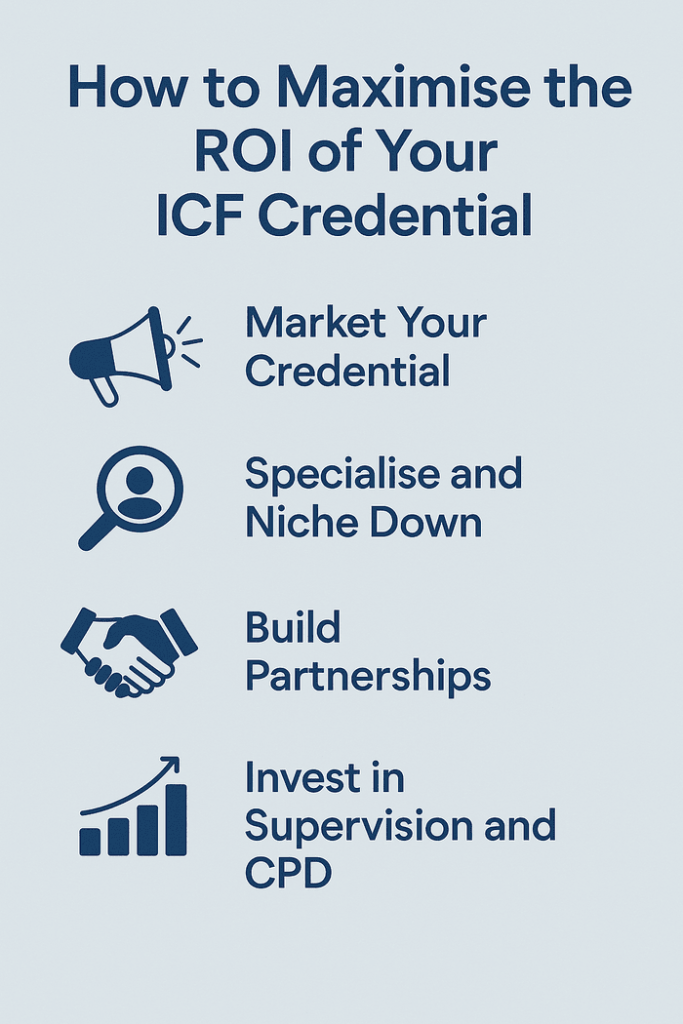
Earning a credential is only part of the equation. To reap the full benefits, take proactive steps:
As the coaching industry grows and clients become more discerning, professional credentials will only gain importance. By earning your credential and leveraging it strategically, you position yourself as a trusted expert, ready to serve clients at the highest level and generate the income you deserve.
Coaching Excellence Solution-Focused Coaching vs. Traditional Coaching: What’s the Difference? Published October 9, 20265 min readSolution-Focused Leadership Table of Contents...

Coaching Insights Early Recognition and Prevention of Workplace Burnout Published October 7, 20265 min readSolution-Focused Leadership Table of Contents Quick...

Coaching Insights The Delegation Framework: Scaling Your Impact Through Empowerment Published October 5, 20265 min readSolution-Focused Leadership Table of Contents...

Coaching Insights Deep Work in a Distracted World: Building Your Focus Shield Published October 3, 20265 min readSolution-Focused Leadership Table...

ICF Credentials: ACC, PCC and MCC Build Your Coaching Career with a Globally Recognised ICF Credential Explore ICF-Accredited Coach Training...

Coaching Insights Overcoming Impostor Syndrome in High-Growth Roles Published October 1, 20265 min readSolution-Focused Leadership Table of Contents Quick Jump...

Executive Coaching The Art of Strategic Refusal: How to Say No Without Burning Bridges Published September 29, 20265 min readSolution-Focused...

Coaching Excellence The ‘Mental Clutter’ Reset: 4 Neuroscience-Backed Habits to Reclaim Deep Focus Published September 27, 20265 min readSolution-Focused Leadership...

Coaching Excellence Why Traditional Goal Setting Fails: The Solution-Focused Architecture for Lasting Change Published September 25, 20265 min readSolution-Focused Leadership...